
Nylon Drawstring Pouches for Organizing Electronics and Camera Gear
Key points
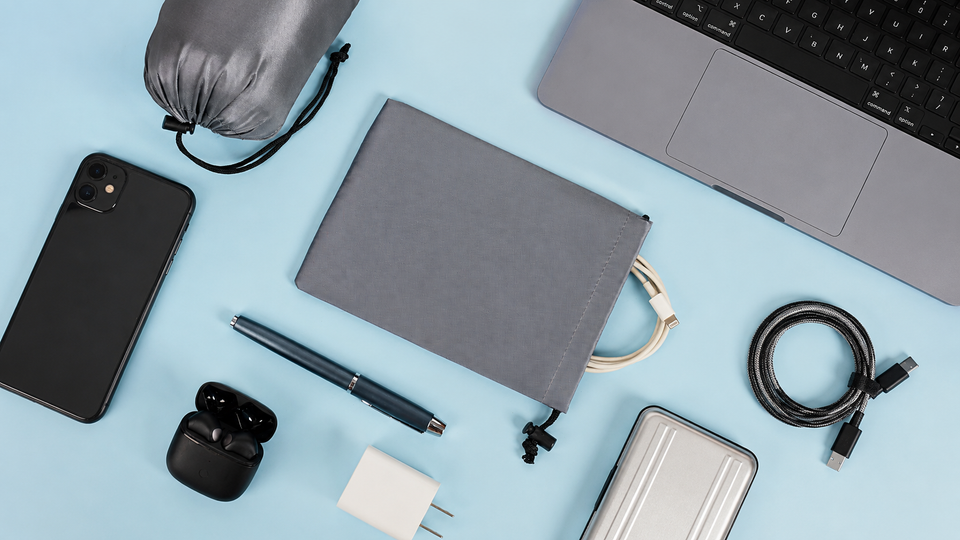
Nylon drawstring pouches are particularly useful for organizing cables, chargers, adapters, batteries, small camera accessories, and other loose equipment. Their main advantage is not heavy-duty protection. It is separation and organization. They keep related items together while remaining lighter and more flexible than rigid cases.
Different pouch sizes can create a simple modular system inside a backpack, camera bag, suitcase, or equipment case. The specification matters. Poorly constructed seams can fail when pouches are overfilled, while nominal dimensions do not always represent the amount of usable interior space. Nylon pouches should generally be considered organizers rather than protective cases unless specifically designed with padding or water-resistant construction.
Introduction
Electronic equipment has a habit of multiplying. A camera may occupy one compartment of a bag, but around it accumulate charging cables, spare batteries, memory card readers, adapters, microphones, power banks, filters, cleaning equipment, and assorted connectors. Laptop and mobile accessories create much the same problem.
The result is often a bag containing expensive equipment surrounded by a surprisingly disorderly collection of small objects. Nylon drawstring pouches offer a very simple alternative to carrying everything loose. Instead of trying to turn one large backpack or equipment case into a perfectly divided storage system, individual groups of accessories can be placed into separate lightweight pouches. The concept is uncomplicated, but for many users that is precisely the attraction.
The practical problem: organizing all the equipment around the equipment
Camera and electronics bags are usually designed around the largest objects. A camera body, lens, laptop, tablet, or drone may have a dedicated compartment, but smaller accessories are harder to accommodate efficiently. Those accessories also tend to be the things people need to find quickly.
A photographer may want batteries in one pouch, charging equipment in another, and cleaning accessories in a third. A traveler might separate computer cables from international plug adapters and mobile-phone accessories. Someone carrying audio or video equipment can use additional pouches for microphones, connectors, memory cards, and miscellaneous hardware.
This approach turns a larger bag into a modular storage system without permanently dividing the available space. It can also make moving equipment between bags easier. Instead of transferring a collection of individual cables and accessories from a camera bag to a backpack, the relevant pouch can simply be moved as one unit. That is where the humble drawstring pouch becomes surprisingly useful.
Why nylon drawstring pouches work
Nylon is well suited to this type of organization because it can be lightweight, flexible, and relatively compact. A rigid electronics case protects its contents but occupies essentially the same amount of space whether it is full or nearly empty. A simple nylon pouch behaves differently. It conforms more closely to what is inside and can usually be folded or compressed when not needed.
The drawstring closure also has advantages for equipment organization. It provides quick access without requiring the precise alignment of a zipper, and there is no zipper hardware to rub directly against nearby equipment. Using several pouches can also provide visual and functional separation. Different sizes or colors can represent different categories of equipment. The user begins to recognize the pouch rather than search through its contents.
That becomes particularly valuable when traveling. A pouch containing charging equipment can come out of the suitcase at the hotel. A camera-accessory pouch can move into a day bag. Items that are not needed remain packed. The system is simple because it does not require the bag itself to provide all the organization.
Limitations and common mistakes
A nylon drawstring pouch should not automatically be treated as a protective camera case. Unless a pouch has specifically been designed with padding, it provides little protection against significant impacts or crushing. A lens, camera body, hard drive, or other delicate device may still require a padded case or compartment.
Water protection is another area where assumptions can cause problems. Nylon fabric does not automatically make a finished pouch waterproof. Water can potentially enter through the fabric, seams, or drawstring opening depending on the construction.
There are also practical limits to how much should be packed into a lightweight pouch. User experiences with this type of bag show that seam strength can become a weakness in some products. Filling a pouch tightly with dense chargers, adapters, batteries, or other relatively heavy objects places considerably more stress on the seams than filling the same pouch with clothing or other soft items.
Size can be misleading as well. The stated dimensions of a flat pouch are not necessarily the same as its practical capacity once bulky objects are placed inside. Seams, closure construction, and the three-dimensional shape of the contents can all reduce usable space. Choosing a pouch with some extra room is usually more practical than trying to match its dimensions exactly to the object being stored.
How to choose the right specification
Start with what the pouch is expected to do. For cables, lightweight adapters, memory-card cases, and cleaning accessories, a relatively simple nylon pouch may be sufficient. For heavier equipment, seam construction and fabric strength become more important.
Size should be considered in terms of both the object and the way it will be used. A pouch that is technically large enough for a charger may become awkward if the charging cable must be forced into the remaining space. A little spare capacity also makes the drawstring easier to close.
For an organization system, buying or specifying several sizes can be more useful than using identical pouches for everything. Small pouches can contain memory accessories or connectors, medium ones can hold charging equipment, and larger versions can accommodate bulkier cables, headphones, or related gear.
Color can also become part of the system. Rather than opening several identical black pouches, users can associate different colors with particular categories. For professional or repeated use, construction deserves particular attention. Reinforced seams, appropriate stitching, secure drawstring channels, and suitable cord materials may matter more than decorative details.
Business and wholesale applications
The same organizational principle has useful commercial applications. Camera manufacturers, electronics brands, production companies, IT departments, rental businesses, audiovisual suppliers, and equipment distributors often need a simple way to group accessories with a primary product.
A customized drawstring pouch can separate power supplies, cables, adapters, installation components, or spare parts within a larger package. It can also remain useful after the original packaging has been discarded.
For equipment rental businesses, different colors or printed identifiers can help distinguish accessory groups. An audiovisual kit, for example, might use separate pouches for cables, microphones, adapters, and power accessories.
Businesses specifying pouches for these purposes should consider the actual weight and shape of the intended contents rather than selecting a generic size first. A pouch intended for lightweight cables has different construction demands from one regularly carrying dense batteries or power adapters.
Conclusion
Nylon drawstring pouches will not replace padded camera cases, waterproof electronics bags, or purpose-built equipment protection. They solve a different and much simpler problem. They organize the clutter surrounding modern electronic equipment.
For photographers, travelers, technicians, and everyday users, separating chargers, cables, batteries, adapters, and accessories into individual pouches can make a backpack or equipment case considerably easier to manage.
The best results come from treating the pouch as part of an organizational system rather than as protective packaging. Choose enough capacity, avoid overloading the seams, and use more substantial protection for fragile or valuable equipment. Sometimes organization does not require a complicated solution. It just requires giving everything its own place.
Published by Palterwear
Palterwear develops customized bags for businesses and organizations that need packaging or organizational solutions tailored to a particular product or application. Nylon drawstring pouches can be produced in custom sizes, materials, colors, and closure configurations, with options such as printing, labels, and customized packaging where appropriate. More information is available at palterwear.com.